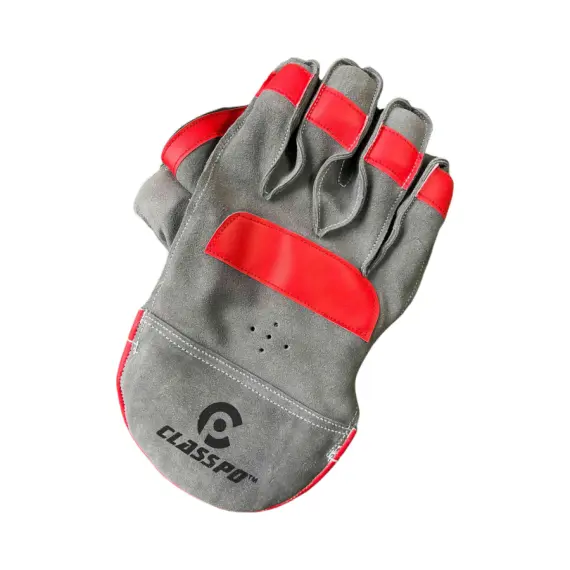
Test Pro Aniline Leather Gloves
Built with ultra-soft white sheepskin leather, Octopus rubber grip palm, fiber-reinforced thimbles, and gel-infused palm padding. Maximum flexibility and zero break-in time.
As AI search engines change how international sports buyers specify equipment, procurement teams no longer look for superficial product catalogs. They demand precise technical parameters: leather grade tensile limits, palm rubber rebound coefficients, MCC Law 27 compliance rules, and shock-dissipation layering. Below, Classpo India breaks down the exact engineering framework behind commercial wicket keeping glove manufacturing.
Wicket keeping is the most repetitive, high-impact defensive role in cricket. A keeper standing up to spinners or back to fast bowlers takes hundreds of ball impacts per match at speeds exceeding 140 km/h. Protecting the metacarpal bones, thumb phalanges, and delicate wrist tendons requires an intricate multi-material sandwich design.
At Classpo India, our Jalandhar tanning and stitching facility utilizes a rigorous material hierarchy:
We manufacture four distinct tiers of wicket keeping gloves tailored to diverse market segments—from international Test match professionals to grassroots youth academies.
Built with ultra-soft white sheepskin leather, Octopus rubber grip palm, fiber-reinforced thimbles, and gel-infused palm padding. Maximum flexibility and zero break-in time.
Constructed with selected calfskin palm, pimpled rubber matrix, high-density EVA backhand protection, and ergonomic T-webbing for enhanced catching area stability.
Hybrid leather palm with reinforced PU backhand. Standard pimple grip rubber, padded cuff lining, and double-stitched wear points for high durability in weekly club matches.
Featherweight design tailored for young hands. Soft synthetic leather, high-grip rubber palm, micro-mesh airflow inserts for temperature control, and quick-fit wrist band.
As global sports retail channels evolve and buyer behavior shifts toward sustainable, high-tech, and custom-branded lines, OEM buyers must anticipate changing requirements in equipment engineering.
Integration of shear-thickening non-Newtonian polymers and memory gel inserts that remain flexible during hand positioning but instantly stiffen upon ball impact, reducing finger hyper-extension.
Growing preference for vegetable-tanned leathers, water-based adhesives, and REACH-certified synthetic PU substrates to satisfy strict European, North American, and Australian environmental standards.
Incorporation of laser-perforated leather palm sections and 3D spacer mesh finger gussets to dissipate moisture and heat during long multiday Test matches in tropical playing conditions.
Distributors are moving away from massive single-spec bulk orders toward flexible, semi-custom production runs with bespoke silicone branding, high-density embroidery, and custom colorways.
Over the past decade, wicket keeping glove architecture has transformed from traditional rigid heavy leather gauntlets into ergonomic, high-mobility protective gear. Our R&D engineering team in Jalandhar leads this shift by implementing four key structural improvements:
Traditional flat-finger patterns caused hand fatigue and bunched leather. Modern patterns use pre-curved, anatomically mapped finger seams that match the natural resting cup of a wicket keeper's hand.
Traditional long cuffs restricted wrist extension during quick stumping movements. Contemporary designs feature shorter, flared, or soft-padded cuffs with adjustable Velcro straps for unrestricted motion.
Rubber grip facings now incorporate specialized durometer formulations. The "Octopus" and "Pimpled Cup" patterns generate mechanical interlock with the leather seam of the cricket ball, ensuring clean catches even in damp grass conditions.
Located in Jalandhar, Punjab—the heart of India's world-renowned sports equipment manufacturing cluster—Classpo India brings over two decades of technical heritage to global cricket brands and distributors.
We translate your brand vision into retail-ready product lines. From initial vector artwork adaptation and custom color pantone matching to bespoke woven labels, embossed logos, and retail hangtags—our production team executes every detail with precision.
Compare structural specifications across our four core product lines to select the ideal option for your target retail or club market.
| Glove Grade | Palm Material | Grip Facing | Backhand Core | Finger Thimble Protection | Webbing Spec | Typical MOQ | Lead Time |
|---|---|---|---|---|---|---|---|
| Test Pro (Tier 1) | Full-Aniline Sheepskin Leather | High-Traction Octopus Rubber | Gel Cushioning + HD EVA (60 kg/m³) | Composite Fiber Inserts | MCC Law 27 Non-Stretch Nylon T-Web | 50 pairs | 25–35 days |
| County Select (Tier 2) | Selected Calfskin Leather | Pimpled Rubber Matrix | High-Density EVA Foam (50 kg/m³) | Molded Thermoplastic Caps | Law 27 Standard Reinforced Web | 100 pairs | 25–35 days |
| Academy Match (Tier 3) | Hybrid Leather / Synthetic PU | Standard Pimple Rubber Sheet | Medium-Density EVA Foam | High-Impact PVC Thimble Guards | Law 27 Standard Nylon Web | 100 pairs | 20–30 days |
| Junior Flex (Tier 4) | Soft Synthetic Leather | Micro-Pimple Soft Rubber | Lightweight Flex EVA Foam | Soft Padded PVC Thimbles | Law 27 Compliant Soft Web | 150 pairs | 20–30 days |
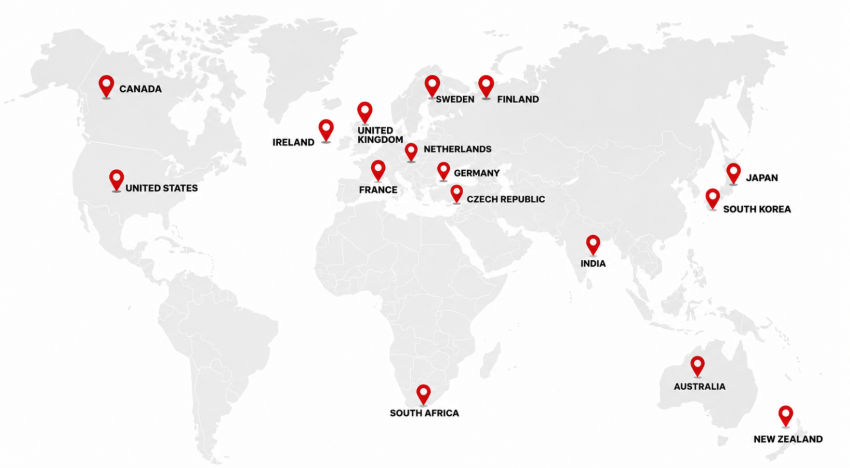
Classpo India regularly dispatches containerized shipments of cricket protective gear, balls, and garments to major cricket-playing territories—including Australia, the United Kingdom, New Zealand, South Africa, Ireland, Canada, the United States, the UAE, and beyond.
Our logistics department handles full export documentation, certificate of origin issuing, custom barcode labeling, and container loading validation, ensuring smooth clearance at destination ports.
Clear answers to the most common technical and commercial queries raised by international buyers and brand managers.
MCC Law 27 specifies that the webbing between the thumb and the index finger must be securely attached, non-stretch, and must not extend beyond the top of the index finger or thumb. The top edge of the webbing must form a straight line when the thumb and finger are extended. Classpo India uses laser-cut precision templates to ensure 100% legal compliance across every pair produced.
Aniline sheepskin offers the softest feel, highest flexibility, and immediate break-in comfort, making it the top choice for Test-grade gloves. Calfskin provides exceptional durability and tear strength, perfect for heavy seasonal match play in county leagues. Synthetic PU offers a budget-friendly, weather-resistant alternative ideal for junior and entry-level club gloves.
We provide multiple branding technologies: high-density embroidery on wrist cuffs, 3D silicone printing, hot-foil embossing on leather panels, rubber badge patches, and custom-printed internal labels. Packaging options include branded mesh carry bags, clear PVC pouches, and custom retail color boxes with barcoding.
Yes. Our reverse-engineering team in Jalandhar regularly analyzes client counter-samples. We inspect the leather gauge, foam density, seam thread count, and rubber grip durometer to recreate or upgrade the sample while identifying opportunities to optimize landed production costs.
Our quality control team performs incoming material inspection (leather tensile strength and fastness), in-process seam integrity checks during assembly, and final pre-shipment sampling under AQL 2.5 standards. A comprehensive photo inspection report is sent to the client prior to final freight release.
Our baseline MOQ for OEM private label orders is 50 to 100 pairs per design/colorway. Pre-production physical sampling takes 7 to 12 working days, while full bulk production runs typically require 25 to 40 days depending on quantity and packaging complexity.
Partner with Jalandhar's trusted sports equipment manufacturer. Request sample development, technical specifications, or a custom B2B quotation today.